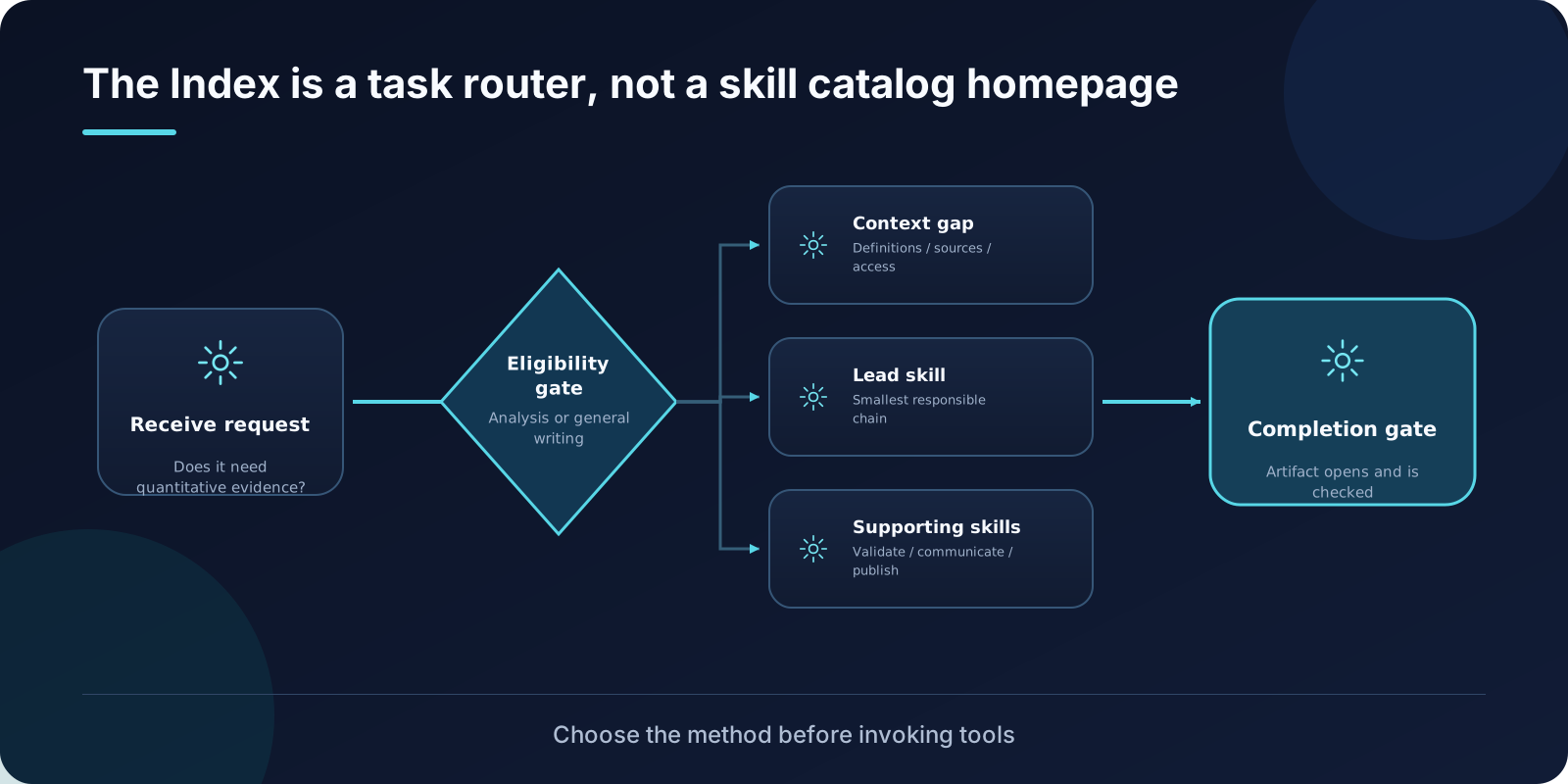
A data agent may know how to design metrics, diagnose anomalies, inspect quality, run notebooks, draw charts, build dashboards, and publish reports. That breadth creates a subtle failure mode: every tool contributes, yet no component owns the actual question.
The Index in the Data Analytics Skills collection is interesting because it acts less like a homepage and more like a control plane. It decides whether a request belongs in analytics, which workflow owns it, how conflicting sources are handled, and what “done” means.
Gate one: is this an analytics task?
“Write a report,” “research the market,” and “validate this idea” are not sufficient signals. The useful test is whether the answer depends on structured records, quantitative measures, or computable evidence—and whether someone will use that evidence for a product, operational, or resource decision.
Misrouting ordinary writing into analytics creates unnecessary queries and false precision. Misrouting a quantitative decision into general writing skips the evidence checks that make the result useful.
Give one skill primary responsibility
Several skills may participate, but one should own the outcome.
| Request | Lead skill | Supporting skills | Completion condition |
|---|---|---|---|
| “Why did weekly active users fall?” | metric-diagnostics | context gathering, reporting | Causes are evidenced and the report is checked |
| “Can this table support the monthly review?” | analyze-data-quality | validation | Risks, gaps, and use conditions are explicit |
| “Build a recurring operating dashboard” | build-dashboard | KPI design, visualization | Definitions, interactions, and refresh are verified |
The lead skill determines how the question converges. Supporting skills add context, verification, communication, or publishing. If every skill merely “helps,” nobody owns omissions.
Available tools are not delegated authority
The router must separate runtime capability, user permission, and task scope. A visible database connector does not grant access to every table. The ability to publish a site does not mean this task authorizes publication.
Capability routing and delivery routing are therefore different decisions: one selects the method; the other controls where the result may be written or sent.
Do not silently merge conflicting sources
A warehouse, BI model, metric specification, semantic layer, meeting note, and old report can all mention the same measure. They differ in authority, freshness, grain, and coverage. Before routing analysis, identify which source controls the definition, which controls the current value, and whether a disagreement changes the decision.
If the conflict cannot be resolved, preserve it and name the owner or evidence needed to decide. Convenient numbers are not necessarily controlling numbers.
“Calculated” is weaker than “complete”
A robust completion gate checks that the lead workflow actually ran; important claims trace to evidence; methods, numbers, and visuals were validated; and the promised artifact exists, opens, and works for its recipient.
That is the Index’s strongest design lesson: an eligibility gate at entry, accountable routing in the middle, and an acceptance gate at exit. Reliable data agents must know when not to analyze, who owns the work, and when the evidence is still insufficient.
When designing a router, start with responsibility contracts—required context, allowed actions, checks, and failure paths—not with a menu of tools. Tools change faster than accountability should.
Reference: OpenAI Data Analytics Skills public reference repository