A first-place Data Agent is not automatically the best procurement choice. A leaderboard says which submissions performed better under a particular task set, data environment, tool policy, budget, and scoring rule. An enterprise needs to know whether the system can deliver under its definitions, permissions, cost, and failure conditions.
The most useful way to read a ranking is backward through its measurement chain.
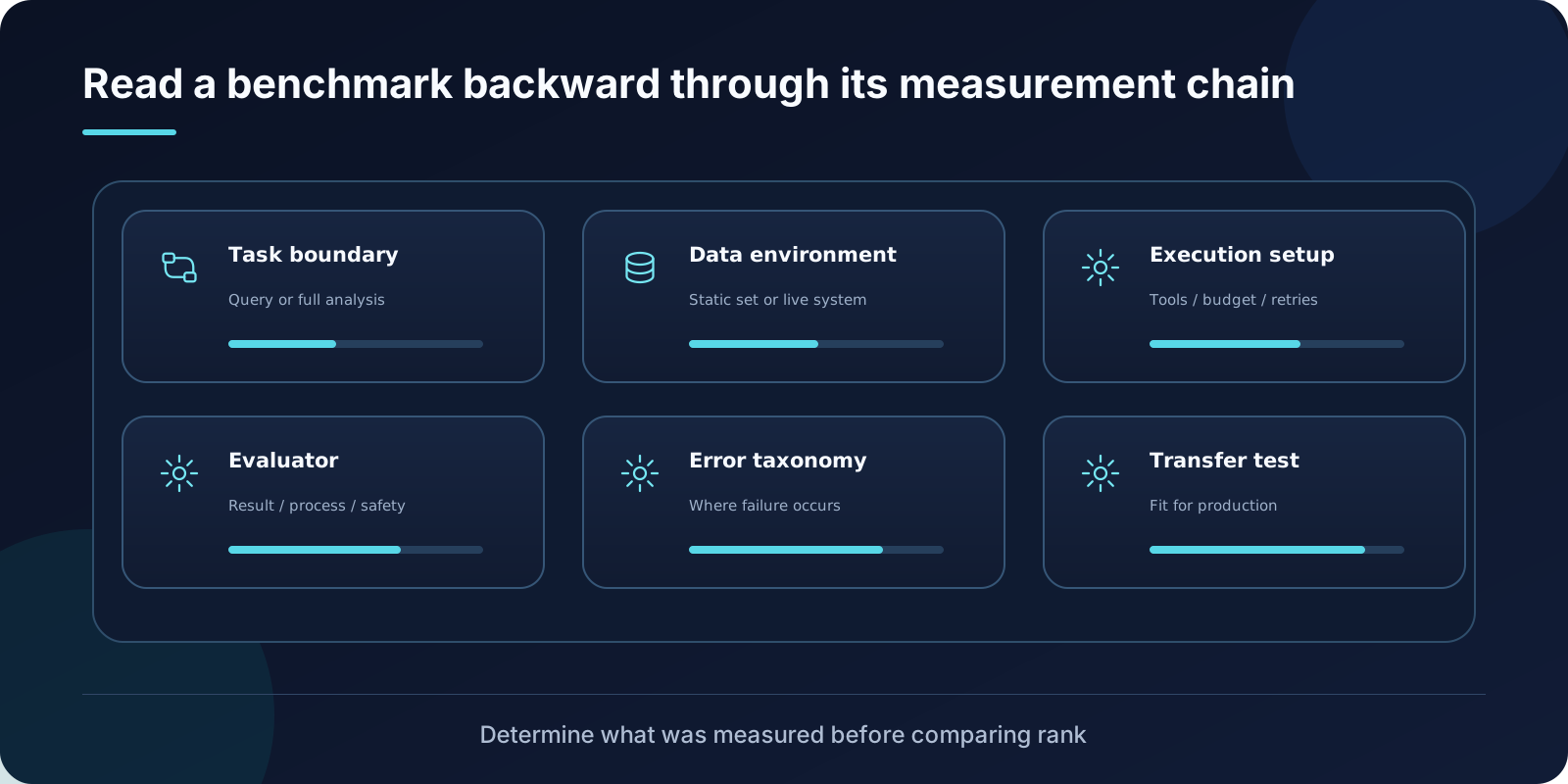
1. What task is being measured?
Text-to-SQL, data-science code, cross-source analysis, and a complete report are different capabilities. Read the input, allowed interaction, and final deliverable. Does the submission return SQL, a result table, a repository, or a cited report? Are multiple tool calls, oracle table names, and retries allowed?
BIRD focuses on Text-to-SQL over large database contents. Spider 2.0 includes enterprise database environments, multiple dialects, and complex workflows. Data Agent Benchmark spans several database systems, inconsistent references, and unstructured information. FDABench includes structured data, documents, web content, images, audio/video, and report tasks. Their scores are not interchangeable.
2. How much data and context are supplied?
Check database and schema versions, documentation, sample values, business knowledge, and access to contents. Does the track provide oracle tables? May the system retrieve external information? Do names or descriptions leak obvious hints?
With correct tables supplied, the test isolates query reasoning. Requiring discovery adds an access-layer task. Both settings are useful, but they must be reported separately. Dynamic web or live-database tasks also need evaluation dates.
3. Is the runtime protocol comparable?
Model version, prompt budget, candidate count, retries, temperature, tools, network, timeout, and spending all influence scores. pass@k is not single-run reliability. Generating 32 candidates and selecting the best one cannot be compared directly with one attempt.
Leaderboards may update evaluators or repair examples. Cite benchmark version, track, submission date, and configuration along with any score.
4. What does the evaluator recognize?
SQL exact match can reject equivalent queries. Execution accuracy is closer to behavior but may reward a semantically wrong query that happens to match a result on one snapshot. Report tasks using model judges or rubrics need calibration, expert review, and bias analysis.
Strong evaluation combines executed results, invariants, structured assertions, and calibrated human or model rubrics. No benchmark evaluator proves an enterprise’s semantics, permissions, or business value.
5. How are failures classified?
Systems with the same total score can fail very differently. One struggles with complex SQL; another chooses the wrong source, leaks data, or fabricates with high confidence. Separate source selection, semantic binding, program execution, analytical inference, refusal, security, timeout, and cost.
Variance matters too. One success in five attempts is not the same user experience as five consistently near-correct outcomes. Report repeated trials and distributions, not only a mean.
6. Will the result transfer to my workflow?
Create a benchmark card covering scope, data, runtime, scoring, risk, maintenance, and explicit exclusions. Select the closest slices and rerun them on internal tasks.
Public benchmarks identify candidates and capability boundaries. An enterprise golden set decides release: real identities, metric versions, snapshots, allowed and forbidden assets, artifact contracts, refusal rules, and error costs.
Benchmark card checklist
| Area | Record |
|---|---|
| Scope | Users, tasks, modalities, language, domain, and exclusions |
| Data | Dataset/snapshot version, oracle inputs, contamination risk |
| Runtime | Model, tools, network, budget, timeout, retries, randomness |
| Scoring | Primary metric, evaluator version, expert review, equivalence rules |
| Stability | Trial count, variance, failure categories, confidence intervals |
| Cost | Latency, tokens, scans, tool fees, and human review time |
| Maintenance | Owner, last update, changelog, and retirement rule |
Turn a leaderboard into procurement evidence
Use two complementary public benchmarks to screen candidates—for example, enterprise Text-to-SQL plus heterogeneous analysis. Then run 50–100 internal tasks under identical identity, snapshot, budget, and stopping policy. Finally, use shadow traffic to observe human correction, policy blocks, latency, cost, and recovery.
If a vendor presents only a rank, request the full runtime configuration, reproducible procedure, error slices, and uncovered scenarios. A one-point lead is often less important than unauthorized access, doubled cost, or unstable long-tail behavior.
Leaderboards are useful within a narrow contract. Establish what was measured, determine how closely it resembles your work, and run a transfer test. Only then can rank become decision evidence.