The Tencent Cloud DataBuddy team announced the new version of DataBuddy during a live stream on the DataFunTalk WeChat video account. The materials do not specify the broadcast date; this article was compiled on October 20, 2026.
Two points are particularly noteworthy: DataBuddy can connect to existing external data sources, not just those on Tencent Cloud; and in the future, models can also integrate proprietary APIs, such as those for Claude and ChatGPT.
This article is based on the content of the launch live stream. Accuracy rates and deployment cycles claimed by the vendor have not been independently evaluated. The text distinguishes between release information and editorial judgment.
Four Task Categories
The launch event categorized DataBuddy’s capabilities into four types:
| Category | Function |
|---|---|
| Data Engineering | Generate and orchestrate data pipelines from natural language requirements |
| Data Governance | Inspect metadata, lineage, quality, and security |
| Data Analysis | Conversational data retrieval, reports, dashboards, and anomaly attribution |
| Data Science | Connect data preparation to model training and deployment |
The first three categories are common in Data Agent products. The fourth category warrants separate attention: it connects analysis results directly to model construction and online services, rather than stopping at dashboards and reports.
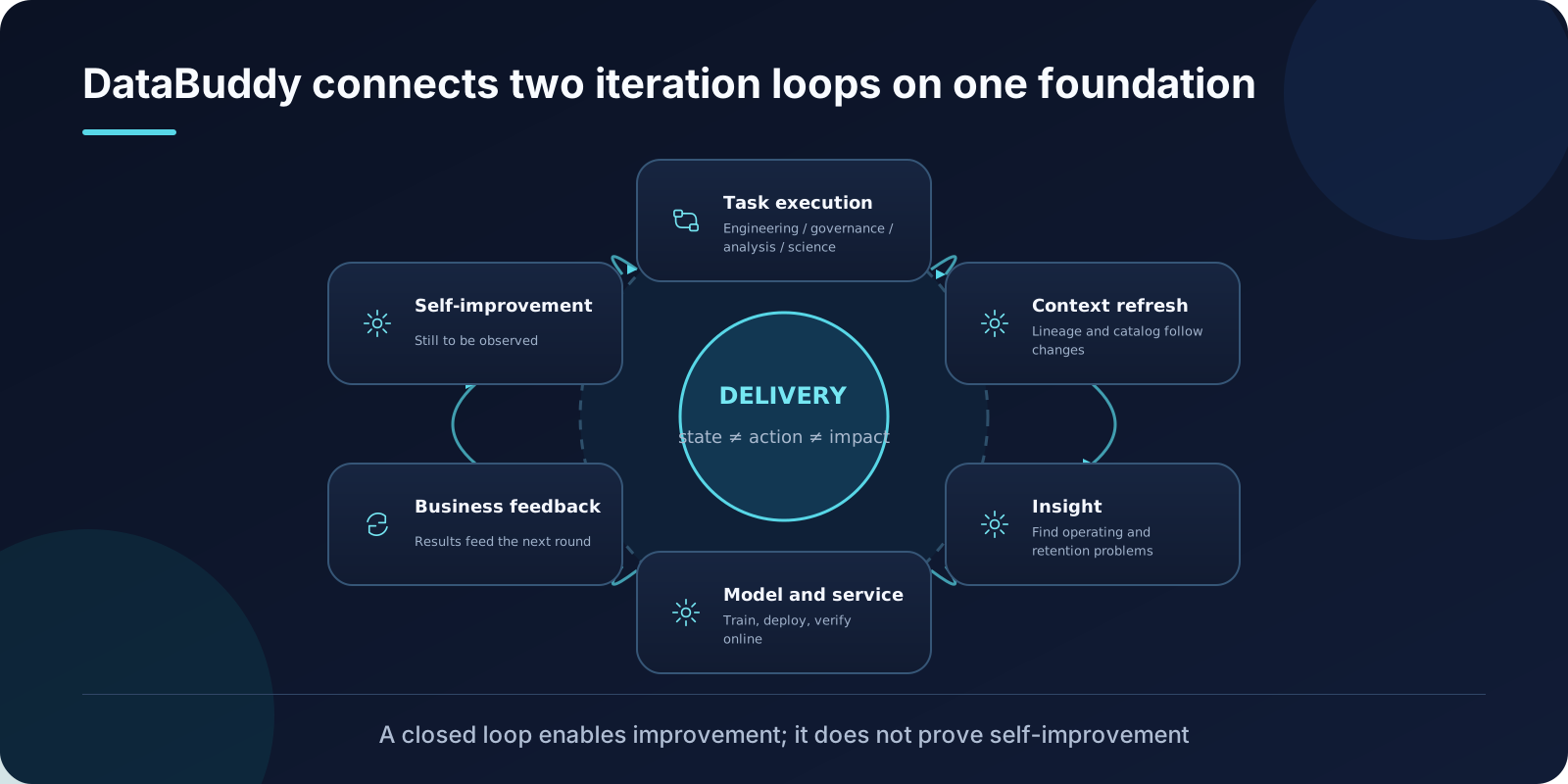
There is also an iteration chain between engineering and governance: as tasks execute and governance changes occur, the system automatically updates relevant data lineage, Catalog, and other information. This ensures that data context evolves with actual work to support subsequent tasks.
Launch Demonstration Workflow
The demonstration revolved around “How is business performance? Why is repurchase weak? What should be done next?” connecting three segments:
- Data Engineering: Build ETL data flows to supply data for analysis and modeling.
- Business Analysis: Configure business reports to analyze issues such as repurchase rates.
- Data Science: Construct models and deploy online recommendation services.
This sequence illustrates the product’s positioning: it is not a single-point Q&A tool, but rather connects problem discovery, hypothesis validation, and implementation of improvements into a single chain.
Three Cornerstones
Unity Semantics
Connect data structures with business definitions using Catalogs, metrics and dimensions, and ontology models.
This aligns with the general approach to semantic layer construction: metadata is responsible for locating assets, the semantic layer unifies definitions, and ontologies express relationships and constraints.
Agent Runtime
Includes user identity binding, high-risk SQL interception, row and column permissions, dynamic data masking, sandbox isolation, and auditing.
The introduction of security capabilities is noteworthy but should not be equated with security certification. During evaluation, conflict tasks should still be designed to observe whether the system blocks issues at the planning stage, rejects them at the tool stage, or filters them only after execution.
OneOps
Integrate DataOps, MLOps, and AIOps on a single foundation to reduce data movement and handoffs between analysis and model development.
This is the foundation for “Data Science” capabilities: if analysis and modeling belong to two separate environments, improvement points will struggle to move smoothly to production.
Two Integration Paths
The launch event presented two methods:
- Direct connection to existing OLAP: Connect to the enterprise’s current data systems, starting from analysis while retaining existing storage and compute resources.
- Migration to unified storage and compute: Cover a more complete set of all four task categories.
This choice itself reflects the product’s realistic positioning: it does not require all customers to first undergo data platform transformation but allows entry through analysis scenarios gradually.
Integration Status of Office Entrances
In the launch event diagram, WorkBuddy is marked as “Integrated”; ChatGPT, Claude, and Gemini are marked as “Coming Soon.”
These two statuses cannot be conflated. “Integrated” means currently available; “Coming Soon” indicates a direction and does not constitute an availability commitment.
My Observation: Two Iteration Chains
The new impression from this launch event is the addition of stronger data science, model construction, and service capabilities.
This brings about a change: within DataBuddy, after analysis insights identify improvement points, one can directly proceed to implementation execution and online validation, closing the entire loop rather than remaining at the level of analysis dashboards and reports.
Combined with the continuous updates to lineage and Catalog by engineering and governance, two iteration chains effectively emerge:
- Business Outcome Feedback: Insight → Model construction and launch → Validation → Feedback for improvement.
- Data Context Update: Task execution and governance changes → Automatic update of lineage and Catalog → Support for subsequent tasks.
I understand that these two iteration chains are creating conditions for future Recursive Self-Improvement (RSI).
It is necessary to emphasize boundaries: creating conditions does not equal realization. Self-evolution implies the system can continuously improve its own strategies and capabilities, which requires evidence over a longer period, including whether improvements are attributable, stable, or prone to drifting from goals. Currently, public information is insufficient to make this judgment.
Questions Worth Verifying
If conducting an evaluation, questions can be divided into three categories:
| Question | Verification Method |
|---|---|
| Is context update truly automatic? | Modify a semantic definition once and observe if lineage and Catalog synchronize |
| Is the closed loop truly connected? | Walk through from insight to model launch and record points of human intervention |
| Does security take effect at the execution layer? | Test blocking positions using unauthorized access, sensitive fields, and large-scale scan tasks |
Launch event materials: 【Materials】DataBuddy Launch Live Stream. Cross-verification: Tencent Cloud Official Product Page.
Compilation date: 2026-10-20. The materials do not specify the live stream date; the catalog date is the compilation date, not the premiere date.