“What was East China revenue yesterday?” and “Should we change product, audience, or outreach after repurchase fell?” are both data questions, but they are different jobs. The first is bounded and quickly verifiable. The second requires decomposition, multiple evidence types, and conditional judgment.
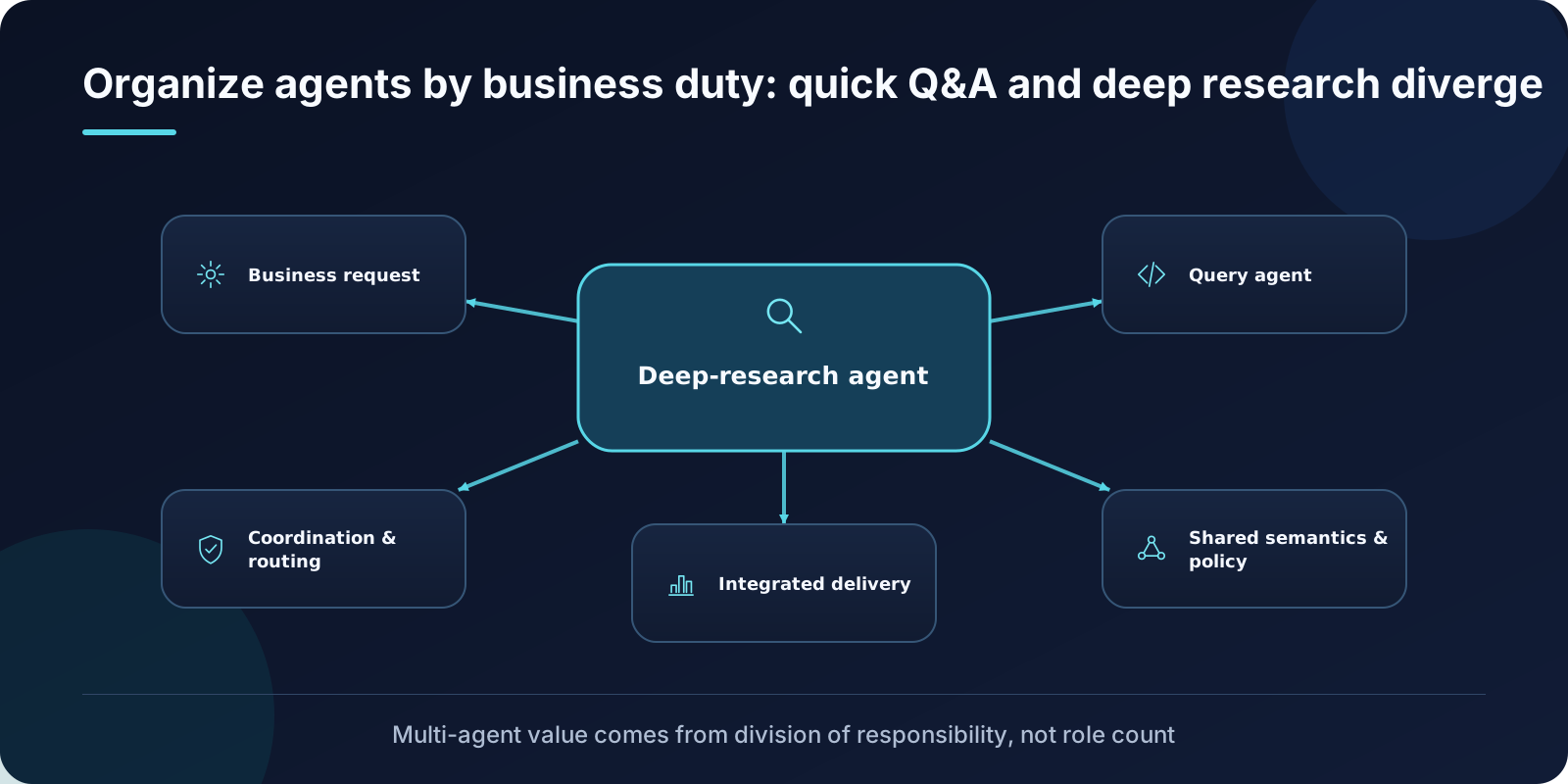
Volcengine separates intelligent data Q&A from deep research. The point is not the number of agents; it is giving different responsibilities different execution paths.
Q&A optimizes for short feedback
Conversational querying fits metric lookup, attribution slices, and follow-up questions. Datasets, fields, and business scenarios need prior constraints, while complex metrics are better stabilized in ETL or a semantic layer. The official documentation places dataset and field limits on an agent and recommends a focused business scenario and intent.
Deep research orchestrates evidence
An open question must become research subproblems before the system decides what data to query, knowledge to retrieve, and tools to call. Its artifact should separate facts, interpretations, hypotheses, recommendations, and unresolved questions.
Shared foundation, different acceptance tests
Both paths require metric semantics, identity, freshness, and audit records. Q&A is accepted when the definition and value can be reproduced. Deep research also needs source coverage, reasoning-gap checks, counterevidence, and conditions on recommendations.
Multi-agent is not arbitrary task fragmentation
If several roles share a vague goal, duplicate data access, and let a model merge results freely, coordination cost rises without accountability. Each path needs an input contract, output contract, authority, and failure destination. A coordinator should decide when a short query must escalate into research.
A useful pilot sends the same business question set through a router: bounded metric requests stay on the short path; cross-domain strategy questions enter research; insufficient evidence forces clarification or a weaker conclusion. Multi-agent value comes from verifiable division of responsibility, not the number of personas on screen.
Reference: Volcengine Intelligent Analysis Agent documentation