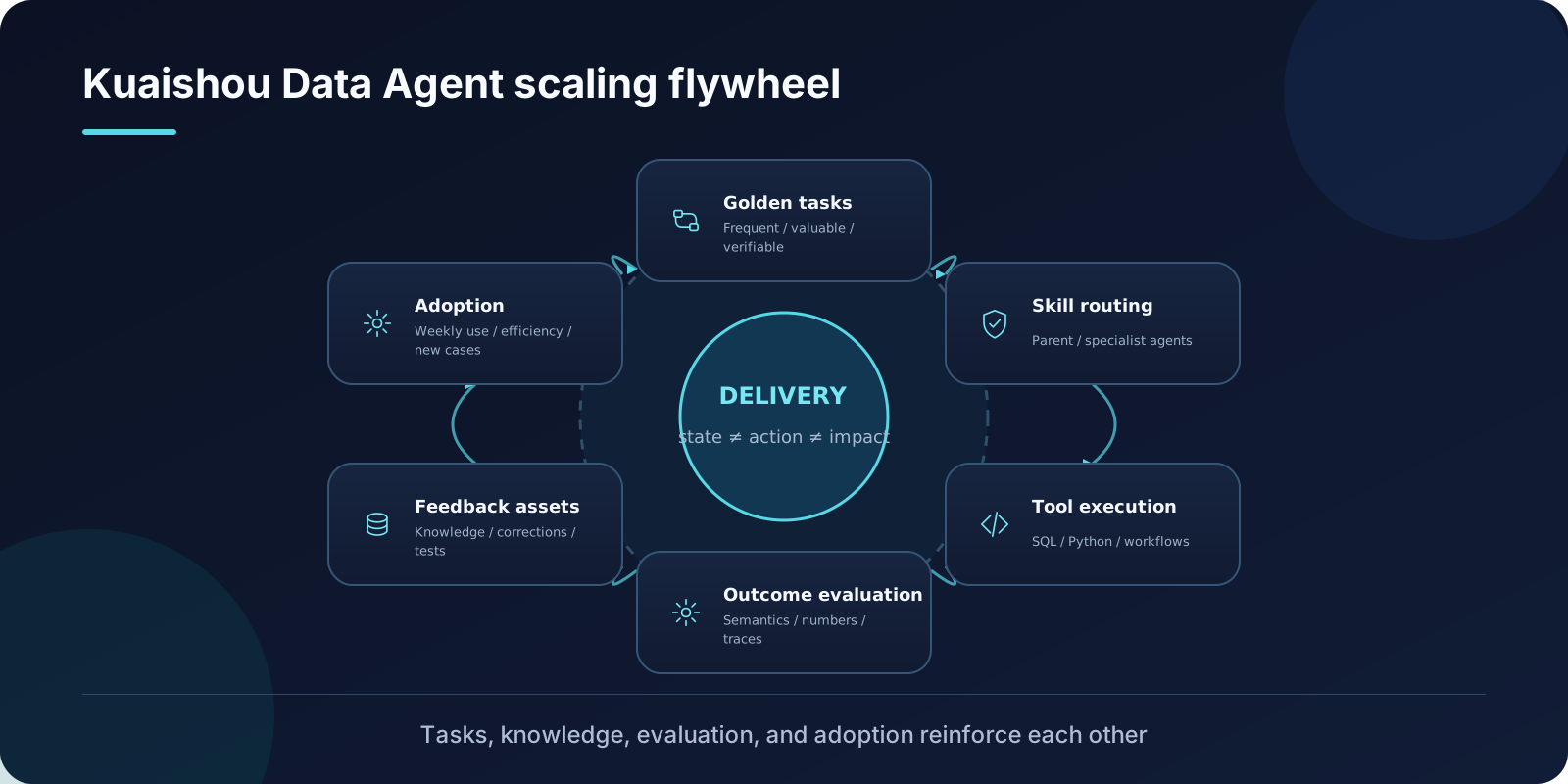
A data agent reaching more than 10,000 weekly active users matters because it has moved into data production, business diagnosis, and recurring delivery—not because a chat box received more prompts. Kuaishou’s September 19, 2026 technical presentation described a progression from bounded workflows to a unified agent entry point.
The presentation reported more than 10,000 weekly users, over 80 percent penetration in core data-analysis and data-operations roles, more than 2,000 Skills, and over 600,000 evaluation records. These are company-reported snapshots, not independently audited results or promises that transfer to another organization. The system relationships behind the numbers are more useful than the headline itself.
Begin with golden tasks whose results can be checked
Kuaishou moved from single-scenario workflows to multiple scenarios, agentic capabilities, and a unified entry point. The path did not begin with a universal agent. It accumulated frequent tasks whose value and results were visible.
A golden task has recurring demand, material time savings, and an output that can be verified through metrics, queries, or artifacts. Reporting, anomaly attribution, data development, and experiment analysis fit this pattern.
A parent agent routes; specialist agents own work
The unified entry point interprets a goal and routes it toward specialist agents for the main app, e-commerce, commercialization, safety, or international operations. Reusable Skills handle methods such as querying, attribution, and reporting.
This architecture assigns responsibility rather than displaying multiple personas. The parent agent chooses the domain and authority; the specialist works inside its data, rules, and tool boundary. The material reported 95 percent routing accuracy as a stage-specific measure. Production teams still need to know how misrouting is detected, corrected, and added to regression tests.
Skills turn methods into organizational assets
Metric discovery, anomaly diagnosis, SQL development, reporting, and governance rules can become reusable Skills. A marketplace creates a distribution mechanism and a place for review and versioning.
Count is not the goal. A useful Skill defines inputs, permitted tools, exception handling, validation, and the deliverable. Two thousand Skills without owners, versions, and retirement policy can create routing and maintenance debt.
The knowledge flywheel addresses accuracy outside the model
Kuaishou links knowledge construction, layered storage, search or deterministic routing, and business applications. Data assets and historical tasks become serviceable knowledge; corrections from real use feed back into knowledge and evaluation.
This is more specific than placing every document in a vector store. Stable metrics can use deterministic resolution, ambiguous questions may require retrieval, and important corrections need scope and version. Knowledge quality itself needs evaluation.
Evaluation checks business outcomes, not only SQL
The presentation breaks result correctness into six simultaneous conditions: metric, filter, dimension, grain, time, and value. Evaluation gates run before release. Online traces connect the session, model calls, tools, and final output; diagnosis and regression follow failures.
Executable SQL proves that an engine accepted the program. It does not prove that the business question was understood. A trace becomes useful only when it leads from an error to a specific routing, semantic, or tool failure.
Workflows produce durable artifacts
One case combined category discovery, creator selection, data comparison, and investment judgment into a site, reducing a near-week process to roughly half a day. Another compressed e-commerce advertising diagnosis to about five minutes and processed 20–50 objects in a batch.
The material also reported substantial gains for reporting, attribution, data development, and A/B experimentation. These are stage- and task-specific company figures, not general performance estimates. The product lesson is that the agent delivered sites, diagnoses, and development results rather than one-off answers.
At this scale, the hard problems become operational: duplicate and obsolete Skills, stale knowledge, evaluation coverage, inference cost, failure recovery, and approval for high-risk actions. Broader adoption also increases the blast radius of a bad metric or permission rule.
The sequence is practical: prove golden tasks, encode methods in Skills, build knowledge and evaluation together, and move the capability into real workflows. Scale is the result of those reinforcing loops, not the starting point.
Source note: based on Kuaishou’s September 19, 2026 Data Agent technical presentation. Adoption, accuracy, and efficiency figures are presentation snapshots or case-specific claims; verified October 6, 2026.