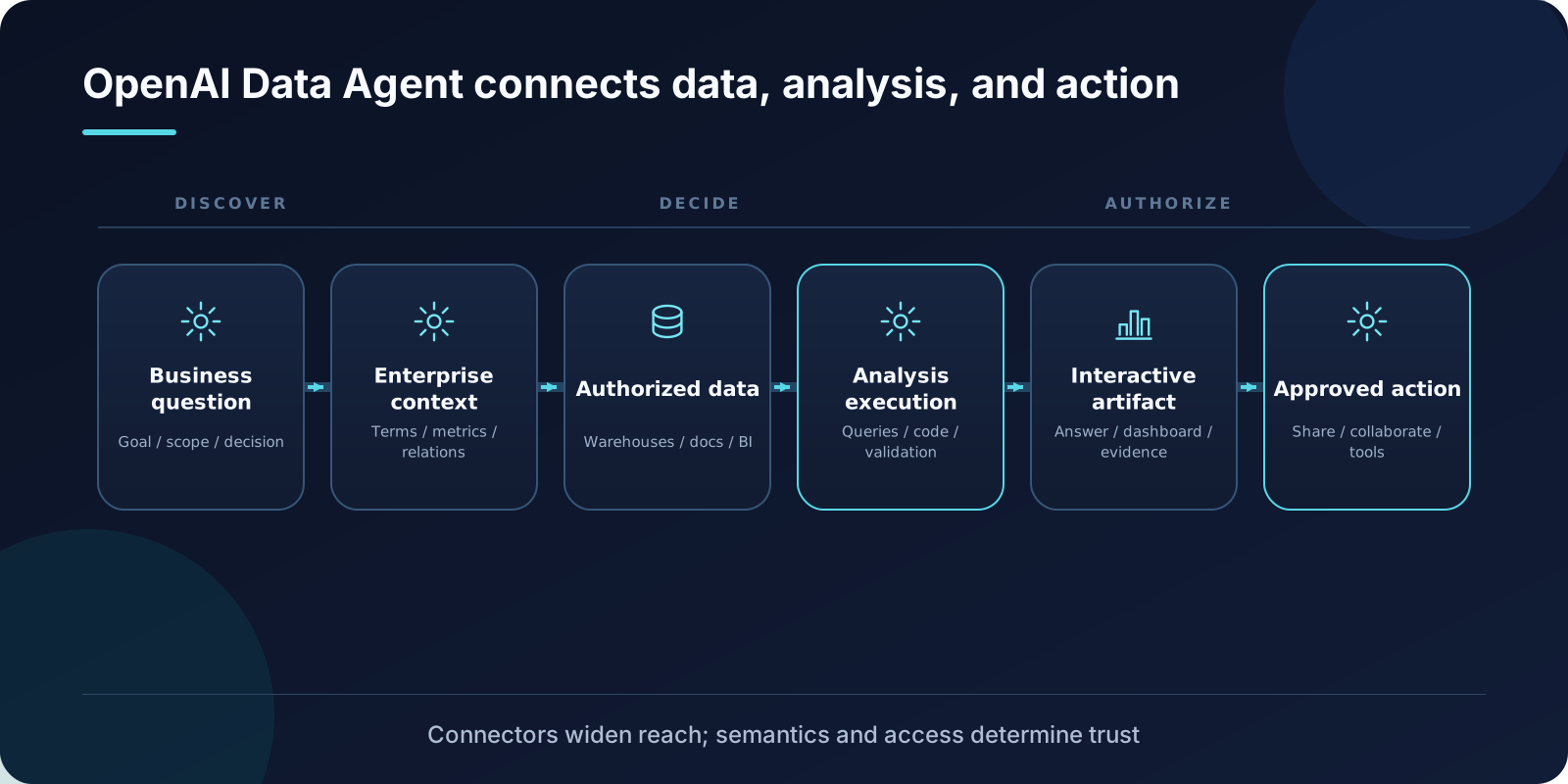
On September 10, 2026, OpenAI launched Data Agent in ChatGPT Work. The release is more than a Text-to-SQL chat interface: it connects enterprise sources, business context, analytical workflows, interactive dashboards, and approved actions in one conversational path.
The competitive question shifts from whether a model can write a query to whether more employees can complete reviewable data work under existing organizational controls.
Data connections and business context enter together
OpenAI lists approved sources including Amazon Redshift, Datadog, Google BigQuery, ClickHouse, Databricks, MongoDB, and Snowflake. Files and documents from Google Drive and SharePoint can also participate.
Connectors solve reachability. The agent also uses business terms, metric definitions, custom calculations, and data relationships from trusted context such as Databricks Genie Ontology, dbt, GitHub, Snowflake Horizon, and BI dashboards.
Those inputs have different jobs. Sources provide records; semantic assets define what those records mean. Without stable definitions, an agent may expose metric conflict faster rather than resolve it.
Analysis becomes an iterative workspace
Within one conversation, a user can investigate a change, compare periods, inspect evidence, and refine scope. The result can become an editable, shareable, refreshable interactive dashboard. OpenAI also identifies Tableau, Power BI, Sigma, and ThoughtSpot among the BI ecosystem partners.
The product change is not merely richer output. Questions, evidence, and artifacts remain available for continued analytical work instead of becoming isolated query responses.
Skills encode analytical methods
The system includes Skills for KPI design, business-context gathering, data context, quality analysis, diagnostics, notebooks, visualization, dashboards, and reports. Connectors answer what may be accessed; Skills describe how a class of work should proceed, be checked, and finish.
A Skill is not proof of measured product performance. Results still depend on source quality, semantic assets, authorization, and the task itself.
Approved action is a separate boundary
The agent can recommend next steps, identify collaborators, share findings through Slack or email, and carry out actions that the user approves through connected tools. Recommendation, action proposal, authorization, execution, and read-back should remain separate states.
If a system shows that a tool was called but cannot prove the target, parameters, recipient, and final state, the path from analysis to action remains incomplete.
Existing permissions still govern access
Administrators enable the plugin, configure sources, and manage availability. OpenAI states that queries follow the connected account’s table, row, and column permissions. Users install Data from the ChatGPT Work Plugins directory, complete the required account connections, and invoke it with @Data.
Deployment therefore extends beyond installation. Organizations still need to govern connected identities, semantic authorities, sensitive fields, residency, logging, and action approval.
OpenAI reports that nearly all of its product team and more than two-thirds of its GTM organization use data agents in ChatGPT Work. Those are company-reported adoption figures, not independently audited results.
The more useful production metrics will be completion of frequent real tasks, traceability of claims, reusable correction, accurate access refusal, and verified action outcomes—not simply the number of connectors or Skills.
Reference: OpenAI, “Now everyone can put data to work”, published September 10, 2026; verified October 6, 2026.